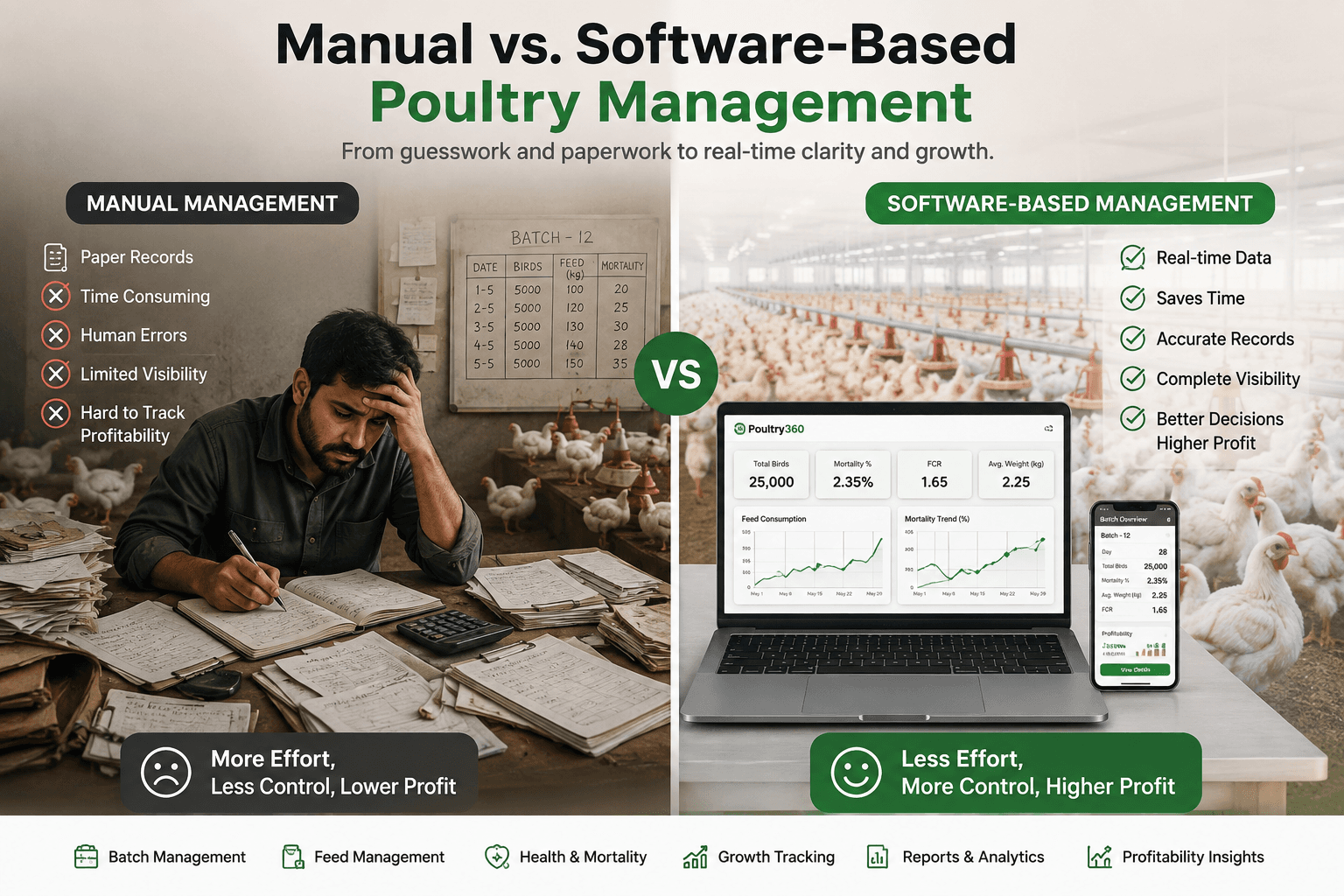
Managing a poultry business has never been simple. Owners and managers have to keep an eye on feed usage, bird health, mortality, batch performance, stock movement, daily expenses, sales, and overall profitability. For a long time, many poultry businesses handled these responsibilities with notebooks, spreadsheets, phone calls, and memory.
That approach may still work for very small operations. But once the business starts growing, manual management usually becomes harder to trust. Delayed entries, missing numbers, duplicate records, and poor visibility begin to affect decisions. In a competitive poultry market, that creates unnecessary pressure on the business.
This is why more poultry businesses are moving toward software-based management. The shift is not only about convenience. It is about improving control, accuracy, and the speed of decision-making.
In this article, we will compare manual poultry management with software-based poultry management, explain where manual methods fall short, and show how Poultry360 helps poultry businesses operate more efficiently and profitably.
What is manual poultry management?
Manual poultry management means recording and monitoring farm activity through paper registers, notebooks, loose bills, spreadsheets, or verbal updates. Many farms use this system to track feed purchases, stock balances, bird movement, mortality, expenses, and sales.
At first, it feels practical because it does not require software setup or staff training. For a family-run farm or a small operation with limited daily activity, manual records may seem enough.
The problem starts when volume increases. More birds, more batches, more suppliers, more team members, and more transactions mean more chances for confusion. A small error in feed entry or stock calculation can affect planning. A missed mortality entry can distort batch performance. A delayed expense record can make profit look stronger than it really is.
Manual systems are easy to begin with, but difficult to scale with confidence.
What is software-based poultry management?
Software-based poultry management uses one digital system to capture, organize, and review operational data. Instead of keeping records in separate notebooks or files, the farm or poultry business stores important information in a structured platform.
This can include:
- batch records
- feed usage
- mortality
- medicine and inventory
- expenses
- sales
- balances
- reporting
- business performance
A good poultry management system helps owners and managers see what is happening without waiting for scattered updates. It reduces repeated manual work, improves consistency, and makes it easier to respond before a small issue becomes a bigger loss.
For businesses that want better control over operations and margin, software becomes a practical advantage.
Where manual poultry management falls short
Manual systems usually do not fail all at once. They create small weaknesses that become expensive over time.
1. Inaccuracy builds quietly
When information is written by hand or updated later in spreadsheets, mistakes are common. Someone may forget an entry, repeat a number, misread a weight, or calculate a total incorrectly. These small issues slowly distort the actual picture of the business.
2. Visibility is limited
Manual records usually show what happened earlier, not what is happening now. If an owner wants to know current feed stock, recent mortality, pending balances, or batch performance, they often have to ask several people or check different files. That delay matters.
3. Reporting takes too long
When the business wants to review profitability, stock movement, mortality trends, or expense patterns, someone has to collect information from multiple sources and compile it manually. This wastes time and often leads to inconsistent reporting.
4. Team coordination becomes weak
As a poultry business grows, more people become involved in daily operations. Workers, supervisors, accountants, managers, and owners may all use different methods. One person updates a notebook, another keeps a spreadsheet, and someone else shares figures by phone. This creates avoidable confusion.
5. Growth becomes harder to manage
Manual systems may survive at a small scale, but they rarely support expansion well. As soon as the business adds more batches, more stock movement, or multiple locations, control becomes weaker and decision-making slows down.
Why software-based poultry management works better
Software solves many of these issues by bringing operational records into one structured system.
1. Better data accuracy
A centralized system reduces duplicated records, forgotten entries, and scattered calculations. The business becomes less dependent on memory and manual reconciliation.
2. Faster visibility into operations
Instead of waiting for end-of-day summaries or paper updates, managers can review operational information more quickly and make decisions with better timing.
3. Stronger inventory and stock control
Poultry businesses handle feed, medicine, birds, eggs, packaging materials, and other inventory items. Software helps track what is coming in, what is being used, and where losses may be happening.
4. Better batch and performance review
When batch data is organized properly, it becomes easier to compare performance, detect unusual mortality, and identify which operations are improving and which are slipping.
5. Easier reporting and planning
Software makes reporting faster and more consistent. Instead of rebuilding numbers manually every time, businesses can review trends, monitor expenses, and plan the next steps with more confidence.
Manual versus software: a practical comparison
At first glance, manual management appears cheaper because it does not involve subscription cost or setup effort. But that comparison is often incomplete. Manual systems create hidden costs through:
- delayed decisions
- entry mistakes
- stock mismatches
- weak reporting
- lost time
- poor visibility
Software requires investment, but it often returns value by reducing these operational leaks.
Manual systems also become heavier as the business grows. More batches mean more paper, more calculations, and more time spent tracking information instead of acting on it. Software handles that complexity more cleanly because it is designed for scale.
The biggest difference is control. Manual systems usually show part of the story. Software helps show the business more clearly.
Business impact of going digital
Moving from manual management to software-based management is not just a process upgrade. It changes how the business performs.
Better record-keeping improves cost control. Better visibility reduces surprises. Better reporting supports smarter planning. Better coordination reduces operational friction.
For poultry businesses, margin is often lost through small leaks across daily operations. Feed waste, stock confusion, delayed updates, missed expense entries, and inconsistent batch tracking all affect profitability. Digital systems help bring these problems into view so they can be corrected earlier.
The shift to software also supports future growth. A business that depends only on notebooks and spreadsheets may struggle to expand without losing control. A business that uses structured software has a stronger base for adding more batches, more staff, or more locations.
How Poultry360 helps poultry businesses move beyond manual systems
This is where Poultry360 becomes useful. Poultry360 helps poultry businesses move from scattered records to one connected management system. Instead of depending on notebooks, delayed spreadsheets, and disconnected communication, teams can work from a shared operational view.
With Poultry360, businesses can improve visibility across:
- stock and inventory
- batch and farm records
- expenses
- sales and balances
- day-to-day performance
That helps owners and managers make more informed decisions with less guesswork.
Poultry360 also supports better accountability. When teams work inside one system, there is less confusion about what was updated, what is missing, and what needs attention. That matters at both farm level and management level.
For businesses focused on profit, Poultry360 can also reveal where losses are happening. Better stock control, clearer reporting, and more structured records make it easier to identify inefficiencies that would otherwise remain hidden in manual workflows.
If your business operates broiler farms, layer farms, hatcheries, or feed-related workflows, you can also explore our dedicated pages for broiler farm software, layer farm software, hatchery software, and feed dealer software.
Who should switch first?
Not every poultry business will move to software at the same speed, but some businesses should switch sooner than others.
Software-based management becomes especially valuable for:
- businesses running multiple batches
- farms with growing daily stock movement
- teams with several staff members
- businesses struggling with delayed reporting
- owners preparing to expand operations
- managers who want clearer control over expenses and performance
Even smaller poultry businesses can benefit if they want better organization and a stronger system for future growth.
Conclusion
Manual poultry management may have worked for many businesses in the past, but the demands of poultry operations today are different. As businesses grow, they need better speed, better accuracy, and better control. That is where manual systems begin to show their limits.
Software-based poultry management gives poultry businesses a more reliable and scalable way to operate. It helps reduce errors, improve visibility, save time, and support better decision-making.
Poultry360 helps businesses make that shift with more structure and confidence. Instead of only recording what happened, it helps teams manage what is happening now and plan what comes next.
For poultry businesses that want to stay competitive, the difference is becoming clearer: manual systems may document the business, but software helps run it better.